
- Summary
- Problem Statement
- Quantitative Analysis on Dilution Effect
- Solutions for Resolving Dilution Effects
- Appendix
Summary
Dilution effects in A/B testing refer to the scenario where unrelated traffic is included in the experiment, thereby reducing its efficiency. Although this phenomenon is widely recognized in the industry, there is a lack of quantitative analysis—at least in common blogs, discussions, or mature packages—regarding the extent of its impact. This blog aims to address this gap by offering insights into when this issue requires careful attention and when it can be safely disregarded.
Given this blog will be relatively lengthy and complex in math, I would like to provide an overview of the main result:
- This blog introduces a scientific formula, complemented by Python code, to quantify the efficiency loss caused by the dilution effect. Using this formula, experiment designers can assess the efficiency reduction and make well-informed decisions about whether to adopt stricter triggering mechanisms.
- In general, a higher dilution proportion results in lower efficiency. However, there are specific scenarios where efficiency remains high even with a significant dilution proportion. This tends to occur when the dilution proportion is reporting a constant value, and the means of the treatment and control groups are close to this constant value.
- Eliminating unrelated traffic either prior to or following the experiment can completely mitigate the dilution effect and we will discuss in details later.
Problem Statement
As previously mentioned, the dilution effect occurs when unrelated traffic is included in the experiment, introducing additional and unnecessary noise into metric calculations and reducing the overall efficiency of the experiment.
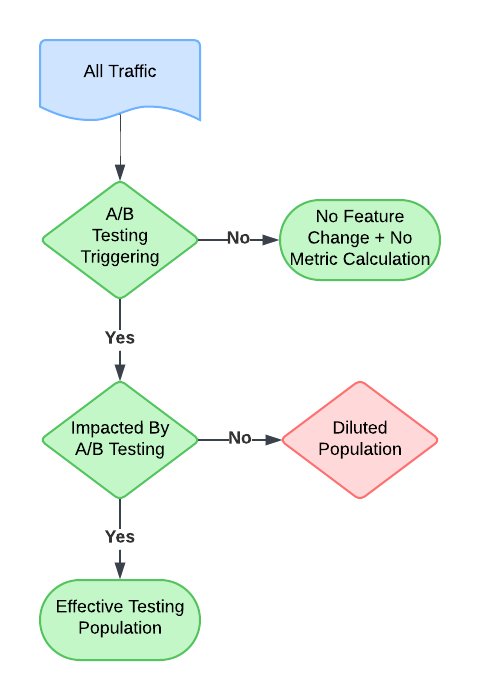
The diagram below illustrates this concept. The dilution specifically corresponds to the red portion, which represents instances triggered by the experiment and reported in the metrics but are not actually affected by the experiment.
It is commonly understood in the data science industry that including diluted traffic reduces the efficiency of experiments. Ideally, experiment triggering should be as closely aligned with the actual change as possible to minimize the diluted proportion. However, this ideal scenario is not always feasible in practice. Various constraints, such as technical limitations, data availability, or operational complexity, may prevent the perfect alignment of triggers with changes:
- It can be due to engineering complexity but whether the user is related to the experiment can be logged.
- Consider the example of testing a drop-down menu on a web page. The experiment is triggered when the user requests the page, but it is unclear whether the user will interact with the drop-down. In this case, users who request the page but do not interact with the drop-down become part of the diluted population.
- To address this, interactions with the page component can be logged and used to adjust for the dilution effect. This approach, which will be discussed in greater detail later, provides a practical way to mitigate the impact of unrelated traffic on experiment efficiency.
- In some cases, dilution effects arise due to unobserved latent variables, making it impossible to log whether traffic is related to the experiment.
- For example, click-through rate (CTR) is a critical metric for measuring ad performance. However, some users exposed to the experiment may constitute a diluted population because their response to the ads is either nonexistent or undetectable. This could occur if:
- They use ad blockers that cannot be detected.
- The ads are entirely irrelevant to them, such as a renter viewing ads for mortgage refinancing.
- In such scenarios, the dilution effect is challenging to address directly, but understanding these limitations is crucial for interpreting experimental results and designing more effective experiments.
- For example, click-through rate (CTR) is a critical metric for measuring ad performance. However, some users exposed to the experiment may constitute a diluted population because their response to the ads is either nonexistent or undetectable. This could occur if:
In both cases above, the dilution effect has a significant impact on the experiment. However, as we will explore later, the existence of logging allows us to almost completely eliminate the dilution effect in the first case. Unfortunately, in the second case, due to the presence of unobserved latent variables, the dilution effect cannot be fully removed.
In addition to the classifications above, experiments with dilution can also be divided into the following two scenarios:
- The diluted part always reports a constant. For instance, in the ads example discussed earlier, users in the diluted population always exhibit no response to the ads. This scenario represents a predictable and consistent dilution effect.
- The diluted part reports non-constant values. For example, in an experiment on a hotel booking website aimed at measuring the number of bookings, users in the diluted population can still make bookings even if they are irrelevant to the experiment. This scenario introduces variability into the dilution effect, making it harder to quantify and address.
Understanding these scenarios is crucial for developing tailored strategies to mitigate the dilution effect and improve experiment efficiency.
Quantitative Analysis on Dilution Effect
Now we come to the exciting and complex part, which is the quantitative analysis. Please follow carefully as we begin by defining certain mathematical notations that will be used throughout the document.
Notations
Assume we are comparing two groups, treatment and control (the conclusion in this document can be easily generalized to the situation of having more than two groups). Assume the populations for treatment and control groups are 


In the classic experiment setting, in both groups, we will observe independent samples 


Now, under a diluted experiment setting, we only can observe 


Then with the diluted data, the corresponding test statistics is 


Main Results and Discussions
The first result presented here is about the property of
Result 1:
, where
.
![\mathbb{E}[\Delta'] = p(\mu_C-\mu_T)](https://s0.wp.com/latex.php?latex=%5Cmathbb%7BE%7D%5B%5CDelta%27%5D+%3D+p%28%5Cmu_C-%5Cmu_T%29&bg=ffffff&fg=000&s=0&c=20201002)

Remark 1:
- Apparently, with
,
. This aligns with our intuition that with less and less diluted traffic, we also lose less and less efficiency.
- Assume
and
, then
. This means if the noise random variable is not a constant, then with more and more diluted traffic, we will eventually lose all detection power. This applies to the second situation that users in the diluted traffic contribute non-constant noise to the final result. In this case, dilution effect can be infinitely bad if there are too much diluted traffic.
- Assume
and without loss of generality, assume
(since we can always subtract
will also monotonically decrease, but it will converge to
. This applies to the first situation we have in the introduction where we are triggering samples from an early step in the funnel and those users who do not observe the difference will only contribute a constant to the final metric calculation. In this case, although dilution effect will still affect the experiment efficiency, it will not be infinitely bad. In fact, if the effort of moving the trigger is larger than the loss on the efficiency, we should do the trade off for it.
- If the distribution on control and diluted part is the same (or very close) and
and
is small (compared to standard deviation), then we will have
, which is a very common cases in industry.
- Some simple code for calculating
From Result 1, we know that the diluted effect does exist, although the impact can be different under different scenarios. Now, the question is about whether we can have other solutions than just changing the triggering users logic.
Assume we can have additional information about the total number of users who could experience the difference designed in the experiment, i.e., we have 


Result 2:
With

- If
![\mathbb{E}[\widetilde\Delta'] \rightarrow \mu_C-\mu_T](https://s0.wp.com/latex.php?latex=%5Cmathbb%7BE%7D%5B%5Cwidetilde%5CDelta%27%5D+%5Crightarrow+%5Cmu_C-%5Cmu_T&bg=ffffff&fg=000&s=0&c=20201002)


Remark 2:
- Noticed that from claim 3 of Result 2, we will have the efficiency to be almost 1, which means asymptotically we will not lose any efficiency in detection.
- Also, the setting of claim 3 is equivalent to marking all values from diluted population to 0, which requires the logging of actual impacted experiment elements.
Deep Dive into Special Cases
In general, there is not much surprising result with both results above, except for the one in the third point of Remark 1, where we concluded that when diluted population in the experiment always produce constant response, the diluted effect will converge to a constant when the dilution proportion converges to 1. Also, if means of treatment and control are not very different from that constant (relatively to standard deviation), the limit of the efficiency will be 1, means we can ignore the dilution effect.
This is in general counter intuitive as we commonly will think that with higher dilution proportion in the experiment, the detection power should converge to 0 as the noise will dominate.
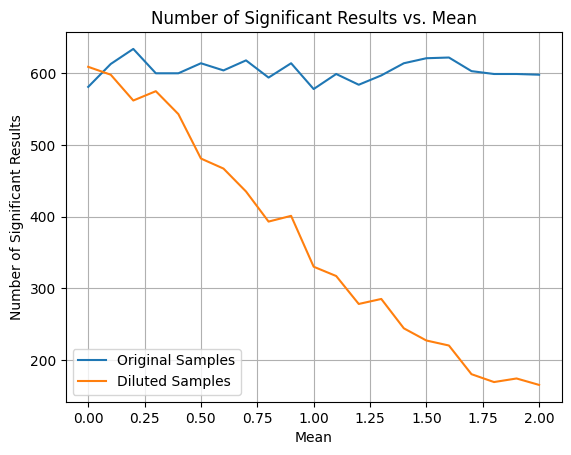
We did the following simulations to validate the result above. Related code can be found here.
We generate two groups 


We first fix 
| Diluted Proportion | Number of Significant Results with Original Data | Number of Significant Results with Diluted Data |
| 0.7 | 596 | 504 |
| 0.3 | 594 | 372 |
| 0.1 | 606 | 336 |
| 0.01 | 598 | 339 |
| 0.001 | 599 | 338 |
We then fix 


Solutions for Resolving Dilution Effects
Now we come to the solutions for resolving dilution effects based on those insights from theory. Here are two ways that can almost fully resolve dilution effect:
- Resolve during experiment triggering: totally remove / reduce diluted population from the experiment when the experiment is triggering.
- Resolve after experiment triggering: keep a full logging of who actually experiences the difference in the experiment and only use them for analysis, or as indicated by Result 2 above, mark all other values to 0 for analysis.
Other than that, we can use the formula or function in the Appendix for calculation and understand if we can tolerate the information loss. If loss is small like those special cases mentioned above, we may save the effort for resolving the dilution effects as either solution mentioned just above may require extra engineer efforts.
Appendix
Note: The proof below is not fully rigorous, may need some mild conditions such that CLT and strong law will hold.
Proof for Result 1:
For Claim 1,
![\mathbb{E}[\Delta'] = \mathbb{E}[X'_C]- \mathbb{E}[X'_T]=p\mu_C+(1-p)\mu_Z-p\mu_T-(1-p)\mu_Z=p(\mu_C-\mu_T)](https://s0.wp.com/latex.php?latex=%5Cmathbb%7BE%7D%5B%5CDelta%27%5D+%3D+%5Cmathbb%7BE%7D%5BX%27_C%5D-+%5Cmathbb%7BE%7D%5BX%27_T%5D%3Dp%5Cmu_C%2B%281-p%29%5Cmu_Z-p%5Cmu_T-%281-p%29%5Cmu_Z%3Dp%28%5Cmu_C-%5Cmu_T%29&bg=ffffff&fg=000&s=0&c=20201002)
For Claim 2, by conditional variance, we have
![\text{Var}(X'_C) = \text{Var}(\mathbb{E}[X'_C|I_C]) + \mathbb{E}[\text{Var}(X'_C|I_C)]=(\mu_C-\mu_Z)^2p(1-p) + (1-p)\sigma_Z^2+p\sigma_C^2](https://s0.wp.com/latex.php?latex=%5Ctext%7BVar%7D%28X%27_C%29+%3D+%5Ctext%7BVar%7D%28%5Cmathbb%7BE%7D%5BX%27_C%7CI_C%5D%29+%2B+%5Cmathbb%7BE%7D%5B%5Ctext%7BVar%7D%28X%27_C%7CI_C%29%5D%3D%28%5Cmu_C-%5Cmu_Z%29%5E2p%281-p%29+%2B+%281-p%29%5Csigma_Z%5E2%2Bp%5Csigma_C%5E2&bg=ffffff&fg=000&s=0&c=20201002)
Similar result can be obtained for

Insert the formula into 
For Claim 3, simply let 

Proof for Result 2:
For Claim 1, apparently 
![\mathbb{E}\big[\frac{\bar{X}'_{C}}{\bar{I}_C}\big]\rightarrow\mu_C+(1-p)/p\mu_Z](https://s0.wp.com/latex.php?latex=%5Cmathbb%7BE%7D%5Cbig%5B%5Cfrac%7B%5Cbar%7BX%7D%27_%7BC%7D%7D%7B%5Cbar%7BI%7D_C%7D%5Cbig%5D%5Crightarrow%5Cmu_C%2B%281-p%29%2Fp%5Cmu_Z&bg=ffffff&fg=000&s=0&c=20201002)
![\mathbb{E}\big[\frac{\bar{X}'_{T}}{\bar{I}_T}\big]](https://s0.wp.com/latex.php?latex=%5Cmathbb%7BE%7D%5Cbig%5B%5Cfrac%7B%5Cbar%7BX%7D%27_%7BT%7D%7D%7B%5Cbar%7BI%7D_T%7D%5Cbig%5D&bg=ffffff&fg=000&s=0&c=20201002)
For Claim 2, we will first study 
![\text{Var}\big(\frac{\bar{X}'_{C}}{\bar{I}_C}\big) \rightarrow \frac{\text{Var}(X'_C)}{N_C(\mathbb{E}[I_C])^2}+\frac{\text{Var}(I_C)(\mathbb{E}[X'_C])^2}{N_C(\mathbb{E}[I_C])^4}-2\frac{\text{Cov}(I_C,X_C')\mathbb{E}[X_C']}{N_C(\mathbb{E}[I_C])^3}](https://s0.wp.com/latex.php?latex=%5Ctext%7BVar%7D%5Cbig%28%5Cfrac%7B%5Cbar%7BX%7D%27_%7BC%7D%7D%7B%5Cbar%7BI%7D_C%7D%5Cbig%29+%5Crightarrow+%5Cfrac%7B%5Ctext%7BVar%7D%28X%27_C%29%7D%7BN_C%28%5Cmathbb%7BE%7D%5BI_C%5D%29%5E2%7D%2B%5Cfrac%7B%5Ctext%7BVar%7D%28I_C%29%28%5Cmathbb%7BE%7D%5BX%27_C%5D%29%5E2%7D%7BN_C%28%5Cmathbb%7BE%7D%5BI_C%5D%29%5E4%7D-2%5Cfrac%7B%5Ctext%7BCov%7D%28I_C%2CX_C%27%29%5Cmathbb%7BE%7D%5BX_C%27%5D%7D%7BN_C%28%5Cmathbb%7BE%7D%5BI_C%5D%29%5E3%7D&bg=ffffff&fg=000&s=0&c=20201002)
Plug in ![\mathbb{E}[X_C']=p\mu_C+(1-p)\mu_Z](https://s0.wp.com/latex.php?latex=%5Cmathbb%7BE%7D%5BX_C%27%5D%3Dp%5Cmu_C%2B%281-p%29%5Cmu_Z&bg=ffffff&fg=000&s=0&c=20201002)

![\mathbb{E}[I_C]=p](https://s0.wp.com/latex.php?latex=%5Cmathbb%7BE%7D%5BI_C%5D%3Dp&bg=ffffff&fg=000&s=0&c=20201002)


For Claim 3, it is a direct result from the first two claims.
R Code for calculation
diluted_efficiency = function(mu_c, mu_t, var_c, var_t
                              , effect_proportion  ## Proportion of user that could experince the difference
                              , mu_z = 0  ## mean of the noise random variable
                              , var_z = 0  ## variance of the noise random variable
                              , sample_ratio = 1   ## sample size ratio between treatment and control
                              ){
  r = sample_ratio
  p = effect_proportion
  enumerator = r*p*var_c+p*var_t
  denominator = r*((mu_c-mu_z)^2*p*(1-p)+(1-p)*var_z+p*var_c) +
                (mu_t-mu_z)^2*p*(1-p) + (1-p)*var_z + p*var_t
  return(enumerator/denominator)
}

## example
diluted_efficiency(2,3,2,2,0.9)
Python Code for calculation
import numpy as np

def calculate_efficiency(mu_C, mu_T, mu_Z, sigma_C, sigma_T, sigma_Z, r, p):
    """
    Calculates the theoretical efficiency using the given formula.

    Args:
        mu_C: Mean of control group.
        mu_T: Mean of treatment group.
        mu_Z: Mean of the Z-distribution.
        sigma_C: Standard deviation of control group.
        sigma_T: Standard deviation of treatment group.
        sigma_Z: Standard deviation of the Z-distribution.
        r: Ratio of treatment group sample size to control group sample size (n_T/n_C).
        p: Probability.

    Returns:
        The calculated efficiency.
    """
    numerator = r * p * (sigma_C**2) + p * (sigma_T**2)
    denominator = (r * ((mu_C - mu_Z)**2) * p * (1 - p) + r * (1 - p) * (sigma_Z**2) + r * p * (sigma_C**2) ) + ( (mu_T - mu_Z)**2 * p * (1 - p) + (1 - p) * (sigma_Z**2) + p * (sigma_T**2))

    efficiency = numerator / denominator
return efficiency Random Thoughts
Leave a comment